Showing posts with label thoughts for writers. Show all posts

Sunday, December 1, 2024

A Writer's Christmas List


December has arrived, and we begin to think about Christmas lists. Lists of things to be done, lists of gifts we must find and purchase, lists of holiday goodies for the teas, lunches, dinners, and parties we might have. But how about adding a wish list of your own? A List of Things A Writer Would Like to Receive.

That list might not be one where your family can run to the nearest Costco or Macy's to find the gift. No. Some of things on that list are mere wishes or possibilities. Let's look at what you might put on a list like this.

A.  A published piece once a month in 2025

B.  The ability to get an idea in your head to be totally coherent in print

C.  Extra time to write

D.  A great critique group that will help you polish your work

E.  A List of Markets that your kind of writing publishes

F.  A few new reference books on the craft of writing, maybe even one

G.  Patience while waiting to hear the status of a submission

H.  A muse who will be positive and give help when needed

I.  To be able to show, not tell, a story

J.  To use sensory details automatically as you write

K.  To use as many active verbs as possible

What else would you add to this list? Think about your writing life and what it has been, what it is, and what you would like it to be. 

If I could put each of the items on the list in a silver box and tie it with a big red ribbon, and send it to you, I would. Your family probably would do so, as well, if possible. Many things on that list are ones only you can find and use. 

It's Christmas, so why not reward yourself? 


Tuesday, March 26, 2024

No Fee, No Pay! Hmmm!

 H U H?

I was skimming through a lengthy list of journals whose closing dates were looming. Many were published at universities, some were in print, others online. As I scanned the list, something jumped out. So many said No Fee and No Pay. Others charged a fee to submit but also said No Pay. Very few in this long list offered payment, but a fair number charged a fee to submit. Most of those were also No Pay. 

As writers, we do want to pay to have our work published. Isn't it supposed to work the other way around? We write, we submit, they pay us. Not so much in the literary journal world today. 

I am fully aware that many publications charge a fee to help offset the expense of publishing, and many are fairly nominal. $3, $5, some even less. So, that shouldn't be a problem for writers wanting to submit, should it? Maybe it can be if they submit frequently. Those $3 and $5 fees begin to add up to a fair amount, especially when the writer receives No Pay and also stands a good chance of being rejected. On to another submission and another fee. 

There are two schools of thought when it comes to writing for No Pay. One group of writers swears they would never, ever write for No Pay. The other group is willing to write for No Pay to beef up their resume, to become a name that readers recognize, to be able to let other publishers know they have been published numerous times. It's a personal choice.

Paying an entry fee for writing contests is a completely different situation. The fees collected are often used for the prize money. That is a bit more acceptable, although there is a wide variation in the amount of the entry fee for contests. If you pay $25 to enter, and your chances of winning are pretty small, should you take the chance on spending that money? Is it like standing on a bridge and flipping one dollar bill after another into the swirling waters below? Some contests charge more minimal fees like $3, but if you enter six categories in one of those, you're spending $18. Again, there are two groups of people here. Those who want to take a chance, and the ones that are reluctant to spend money unless it is a sure thing. Nothing in the writing world is a sure thing, so those people are probably never going to win a contest since they refuse to enter.  

Starting with January 2024, keep a list of the fees you have paid for both submissions and contests. Below that, make another list of the money you have earned through those submissions and contests. How do they compare? Hopefully, money earned will be the greater amount. If it isn't, you may need to do a bit of soul searching. 

Paying a fee to submit when there is the promise of payment is one choice. Paying a fee to submit with No Pay is another. We each have to give thought to which direction we'll take. 


Monday, June 19, 2023

Writer--It's Up to You!


This is a repeat post from 3 years ago. I'm repeating it after a fairly new writer asked me some questions about the writing world. There is no magic pill to swallow to make you a published writer. But there are a number of things you can do to help yourself move along on your writing journey. 

One of my favorite, old-time, movie stars seems to have been a wise woman. Her words in today's poster quote have her wry sense of humor but also tell us something important. 

So many times, I end my posts by saying that it is up to you, the writer, to accomplish whatever the topic had been. In life, we run across people who are always trying to get someone else to do what they probably could or should have been doing themselves. They're directors and usually good at it. As long as others agree to whatever was asked of them, the 'director' will keep right on. 

In our writing journey, that doesn't usually work. Yes, there are some writers who write the first draft, then cajole a friend or group to do all the editing and revising in a critique. It's fine, even recommended, that we have others critique our work, but it's best to ask to have your proofread, edited, and/or revised draft critiqued. Not the first effort. That is up to you.

It's up to you to acquire as much knowledge about the writing craft as you can. It's up to you to read about writing, to attend conferences to learn from speakers, and to learn from a one on one session with another writer. 

It's up to you to educate yourself about the submission process. Learn how to write a query or a cover letter as well as your short personal bio. In our techno world, this is not difficult. Use a search engine on any topic and you'll find myriad articles. 

It's up to you to write and rewrite and rewrite again until you have a piece that satisfies you. It takes time and effort, but the end result is almost always well worth it.

It's up to you to seek inspiration. Successful author, Jack London is often quoted on finding inspiration to write. He said, "You can't wait for inspiration. You have to go after it with a club." Note the 'you' word. It's you who must work at being inspired. Put yourself in a place where you can find it.

It's up to you to submit your work. Aunt Gracie isn't going to do it for you. Cousin Fred isn't about to send your work to an editor. It's your story, your job to find a place and submit.

It's up to you to promote yourself as a writer. The more readers you engage in several ways, the more readers you'll keep and new ones you'll acquire. Let them know who you are by being active on social media, having a webpage and a blog, speaking at conferences, book signings, and more. Wherever you can get your name and your work in front of others will benefit you.

What it all comes to is that you are the one responsible for every step of your writing journey. I have a feeling that Katherine Hepburn did become a household name by sitting demurely at home hoping a Hollywood mogul would discover her. She knew it was up to her to 'paddle her own canoe.'

Thursday, February 16, 2023

Stand Out Among Other Writers


Yesterday, I told you about our prediction of 3-8 inches of snow overnight. I tiptoed to the window when I woke this morning and looked out, expecting to see a white world and snow still falling. Instead, I found that we'd had only a dusting! There was a light covering of snow on the driveway, and now, even that has disappeared. Many closings for today were announced last night. The Kansas State University campus is closed today. The students must be cheering for the unexpected day off. Farther north of us, they did get more measurable snow. 

On to our photo for today. I loved this coffee mug that says 'Be a flamingo in a flock of pigeons.' What does that mean in our writing world? That we should work towards being the writer who stands out among all the other writers. The flamingo stands out when in the midst of a flock of pigeions because it is taller and more brilliant in color. 

How are you going to stand out from many, many other writers? Size and color don't matter a twit. But your ability to write so that readers sit up and pay attention does. How can you achieve that? 

There is no one way, to write on a daily basis is a step in a process. The more you write, the better writer you can become. 

Another is to make the best use of words possible. Do away with passive verbs; work at using as many action verbs as you can. Work at using descriptive phrases, at finding the best adjectives but not overusing them, at giving a distinct sense of place. 

One important way is to find your voice and use it to make your writing unique, to make what you write different from what others write. Your voice is your style of writing, the way in which you tell a story. It's the way your personality shines through and the way you put sentences together and your word choice. When you read the novels of a prolific author, don't you notice a sameness in the way he/she writes? The stories are different, but the author's voice is quite the same. Have you ever heard a reader say "I love the way he writes!" What they love is the voice the writer has developed.

Some writers do something to their physical appearance when they are at an event to make themselves noticeable. They might dress in outlandish clothing, or vintage clothing only, or revealing costumes. They might color their hair a color no one else has so they stand out in the crowd, and they become known for rainbow striped hair or whatever. They're trying to be the flamingo in the crowd, but their physical appearance is far less important than their writing ability. 

We all know that writing is hard work. To be that flamingo who stands out in the flock of writers, you'll need to work especially hard every day. Outstanding writers do not just happen. They are created by determination, diligence, and passion for the writing craft. 

Monday, December 12, 2022

Writer, Where are You Going?

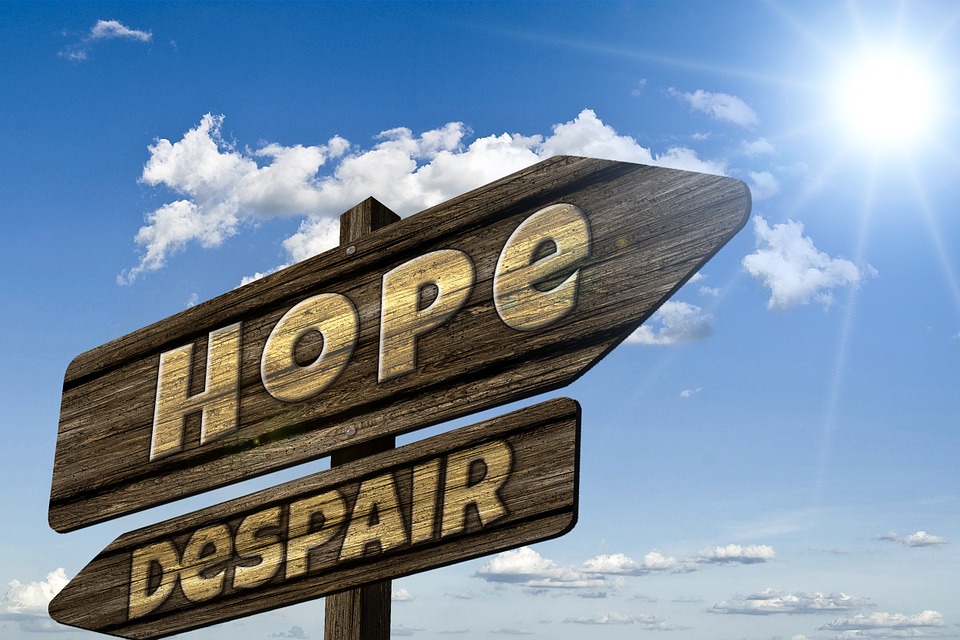
Today's photo is a road marker. It won't lead you to New York City or Las Vegas or San Francisco. Instead, it shows the way to town of Hope and also to the village of Despair. 

As writers, we have a choice between these two. How do you feel about your writing world? Are you often feeling like the rest of the writing world is against you? Do you write, then tell yourself it's pure drivel and no one will want to read it? Do you wonder sometimes why you keep on writing, worrying that it is a lesson in futility? Do you ever decide not to submit what you've written because you think it will most likely be rejected? Do you stay home alone instead of socializing or attending conferences with other writers? If you answered yes to any of these questions, you're probably traveling to Despair, a place where no one feels very good about themself.

Those who move toward Hope enjoy the act of writing. They are isnspired to write by many things in life that they see on a daily basis. They submit their work with a positive attitude. When rejections come, as they often do, they look carefully to see what might be changed before submitting elsewhere. They look at a rejection as a way to learn someting. They enjoy being with other writers and going to conferences where they can learn new things.

As with so many things in our writing life, you have a choice to make. Will you continue on the road to Despair or will you make a change and travel the highway to Hope? I can't make that choice for you. Your family cannot do so either. It's up to you and you alone. 

If you choose the road to Hope, does that mean you'll never feel down about your writing again? Probably not. We all have those (dare I say it?) hopeless feelings on occasion. The problem is when those feelings take over, and you sink deeper into Despair. Make a habit of looking to the positives in your writing life. Developing a good habit doesn't happen overnight. It takes time and patience and persistence. I guarantee that it is worth working toward the good habits a writer should have.


Wednesday, December 7, 2022

A Foggy Morning


Foggy Day

Fog rolled into our area overnight. When I got up this morning, I could barely see across the street. Fog brought many thoughts to mind. I find it rather eerie, depressing, frightening when driving, and more. It's also a good subject to write about, or to include in a story you're writing. Fog lends itself to poetry, too. One of Carl Sandburg's most famous poems is titled Fog. Very short but memorable.

Several years ago, while on a trip, I wrote a short piece about fog and our writing world. I can manage to turn almost any topic to something about writing. I've included it below:

In the Fog

I pulled aside the heavy draperies of the motel room window, hoping to see sunshine. Instead, I found a misty rain and light fog. “Fog again!” I said to my husband who stood before the mirror shaving. 

We’d driven in fog the morning before when we set out from home to travel southeast, in hopes of finding a pocket of warmth during this winter month. As we crossed the hills of south central and southeast Kansas, we ran the gamut from a little fog to heavy curtains of it, blocking the view of the tallgrass prairie we normally enjoyed when driving this route.

I searched the road ahead for tail lights of any vehicles and the headlights of those approaching. At times, one would rise up from the fog, seeming to appear in only an instant. I watched the side roads, worrying that a truck or car would pull out in front of us before they realized we were there. Ken kept watch as he drove, and I offered one more set of eyes to help him. Fog frightens me almost as much as icy roads. 

What upsets me the most on a foggy day is the number of people who drive through it with no lights on. “What kind of idiot drives in fog without any lights on?” I’ve repeated this statement on many an occasion, never receiving any illuminating answer, other than some smart remark from my husband. 

We left the motel on this second morning of our trip, feeling relieved that the fog appeared to be very light. Euphoria lasted only a mile or two, as the arms of heavy fog wrapped around us and held on tightly, as though a lover who would never let go. 

Sometimes we move through years of our writing lives fighting fog, never being able to see clearly to our goals. We let that vaporous air surround us while we sit and wonder why our writing journey doesn’t move faster or rise to a level we’d hoped for long ago.

Sure, we set goals at the beginning but how hard did we work to achieve them? Did we give the ultimate to reach our goals? Or did we take it as slowly as those cars driving through the fog? Did we drive ourselves hard enough and fast enough? Did we search for reasons that we weren’t accomplishing what we’d set out to do? All good questions for which you may or may not have answers.

Maybe we should set another goal to add to our earlier list. Let’s move out of the misty fog to see our previous goals more clearly. Then work at each one with a new attitude. Trade the I can’t for an I can. Let’s move through our list of goals with a new fervor


Friday, October 21, 2022

Painting With Words


I have little to no artisitc talent, but I greatly admire those who do. Instead, I paint with words, as do many others who are writers. There are a few who are talented in both crafts. Super Stars in my book.

Writers, painters, sculptors, potters--all are artists. I wrote a poem on this topic that placed in our Kansas Authors state contest several years ago. You can read it below.

Artists All

Painting with oils,

watercolors brushed across canvas,

clay molded by loving hands, 

marble chiseled to exquisite form


Artists ply their trade,

by the golden light of day

and velvet depths of night,

with passion and verve.


One more artist joins the rank.

The writer brushes words over paper,

molds a story bit by glittering bit,

chisels a novel to survive the ages.


The writer gathers life’s stories 

from country roads to city streets,

written from the depths of a heart

bursting with intensity and rapture.


Artists all, masters of creation,

be they painters, sculptors or writers,

leaving footprints on canvas, marble and paper--

heartfelt tributes embraced by mankind.

                              ...Nancy Julien Kopp (c)

If you're a writer, you're also an artist. You paint with words. You use words to sculpt, to mold, to sketch. The good writer paints those words so that they stand out for the reader with beautiful prose, vivid descriptions, and a definite sense of place. The good writer paints his/her words with emotion. 

Be proud of what you do as you brush words across paper rather than on a canvas. Be proud of what you give to the world. Be proud of what you have accomplished as a word artist. 


Thursday, September 15, 2022

Writers and Pride


There is little more to be said than what today's poster offers to writers.  We move along our writing path by days, months, and years without paying attention to what we have accomplished. We get caught up in the everyday bits and pieces of our writing world and forget to mark our glory moments.

Take a few moments today to look back at how your writing life is different today from when you were the newbie. And if you're still in that newbie category, you can still do this. You may not have a great many achievements to list yet, but perhaps some small satisfying ones. 

Make a list of your achievements. That list doesn't have to include only things you've had published but also ones that brought you satisfaction in some way. Winning some kind of writing award should go on your list. Being a presenter at a writing workshop or conference definitely deserves to be on your list. Or being asked to speak to a group of school children about writing or a book you've written. Also to adult groups. 

If you've ever received a nice note from an editor, that should most definitely hit the list. Or fan mail from readers. 

The more you think about your achievements, the longer that list will be. Read it and pat yourself on the back. You earned it!

Wednesday, September 14, 2022

Make Sure You Have a Story to Tell


Our poster for today is a bit of a revelation. "Tell the readers a story! Because, without a story, you are merely using words to prove you can string them together in logical sentences." 

But, you're probably wanting to tell me that you don't have a 'story' in an essay, or an article, or even some poetry. Most essays have a story of some kind. The essayist often opens with an experience, and that is the same as a story. Then he/she goes on about what that experience showed them or taught them, or how it is part of a universal truth. 

An article can also relate an experience of some kind, but it is filled with science or other facts. And remember, that a story has a beginning, middle, and ending. So does an article. Those who write these articles still pay attention to an opening and the middle, and then bringing it all to a summary or closing. 

Most poems tell a story, even if in the mildest terms. They are not all narrative poems which definitely tell us a story, but there is still that beginning, middle, and ending. 

None of the above will work if all you do is string together words that make logical sentences. It's great to be able to do that, but it's not enough. Even when you write stories for you family stories collection, you need more than those logical sentences. You're telling a story! Be sure it has a beginning, middle, and ending. 

Yesterday, I read a piece written by one of my Followers that was published at a women's memoirs website on their Rosie the Riveter section. Writers were asked to send a story about women helping in WWII. Sara Etgen-Baker wrote a wonderful piece that was told in story form. She could have written a factual memoir stating what happened. Instead, she took the facts and turned it into a true story. And done very well. You can read her story here

I have seen many essays subbed in critiquing groups that received comments like. Pretty words here, but what is the purpose? What are you trying to tell your reader? They are inferring the "where's the story?" situation. 

When you are editing your work, add the question "Is there a story here?' 


Wednesday, September 7, 2022

Building Your Story


Do you remember building with your childhood blocks? Or legos? Or Lincoln logs? You started with the first piece and added layer after layer until you decided it was finished. Or wanted to destroy it! Then build it again. 

We build the pieces we write, too. Whether they are fiction stories, essays, articles, or poems. We start with the idea, that's our ground piece. Then we add things like characters, events, descriptions, sensory detail, sense of place, and more. Each one is another block on top of your first layer, or your idea.

What happens if a child builds his tower of wooden blocks too quickly? It's off center, and before long, it topples to the floor. When we build our stories, we have to do it carefully, making sure each layer is centered and relevant. If we don't, we may end up like the child--starting all over again.

Some writers like lists. Why not make a list of the parts you want to include in your tower of story blocks? The one below is only the main pieces to include. You may think of others to add to your own list. Or you may subdivide any one of mine into smaller and more detailed points.

A. Story idea

B. Characters

C. Sense of Place

D. Sensory Details

E. Description

F. Opening

G. Closing

H. Tense

I. Active vs passive verbs

What other things might you use as building blocks for whatever you're writing? 

I mentioned at the beginning of this post that sometimes children destroyed their tower, only to rebuild. If what you are writing doesn't turn out the way that pleases you, you can knock it down and begin again. 

Children build towers with their blocks. Bakers create wedding cakes, layer by layer. A mason constructs a brick wall, one row at a time. Writers also build their stories, essays, articles, and poems a bit at a time, using many pieces, which hopefully fit together well in the end. 

Thursday, August 25, 2022

Blessings in My Writing World


Yesterday's post centered on rejection and the reactions we have to that situation. So today, let's do a complete reverse and concentrate on the blessings in our writing life.

The one time of the year when most people count their blessings is Thanksgiving, and that's great. But there's a whole lot more of the year when we should do the same. That goes for our writing life, as well as the rest of it.

One of my writing world blessings is this blog. It gives me a platform to be able to give something to other writers. The blog has also given me a connection to writers around the world and allowed me to develop friendships with writers I've never met in person. Thank you Blog!

Another blessing in my writing world is my online writers' group. Oh my, I'm not sure how I'd get along without them. They are a fantastic sounding board. They give critiques on my writing to help me polish a piece and make it ready to submit. They allow me to read and critique their submissions which helps me indirectly, as well. I read the critiques on other peoples' submissions and learn from them. Thank you Writers Group!

I consider my writing world to have blessed me with keeping my mind sharp as I age. Many seniors stop doing things that are considered mental exercise as they continue to age. Instead, they sit mindlessly in front of the tv and do little to improve their minds. Those who read regularly and those of us who write have upped the odds for keeping mentally fit as the years slip by. Thank you writing world!

I feel blessed that my interest in writing has not faded with the years. If anything, it has increased. Thank you interest in writing!

What would I do without social media and search engines? I feel especially blessed with the help and connections I get from these two parts of the tech world. Thank you social media and search engines.

I've been fortunate to have been published many times in magazines, ezines, and anthologies. I've knocked on the door, and often have seen it open for me. Thank you publications!

I've also been blessed to have many rejections. Sound strange? Maybe. I look at each one as an opportunity to learn something that will help me be a better writer. So yes, thank you rejections!

My state writing organization is one of the stars in my writing world. I have gained so much from the meetings and conventions and conversations with other members. Thank you, Kansas Authors Club!

How about you? What blessings in your writing world are you thankful for all year, not just on Thanksgiving? Make a list and then smile big!

Friday, July 29, 2022

Writing on Summer Days


 We're in the middle of summer--hot days, long evenings on the porch or outdoors, hot weather foods and more. Is it harder for you to write in the summertime than any other part of the year? Or does the heat keep you indoors so you are close to your writing area? 

Even if you hibernate in the cool house or apartment, do you use the time to good advantage? Do you carve out certain parts of the day as your time to write? It takes a bit of discipline, and if you have children in the house, your summer days are filled with more activity than usual. It's hard to set time aside to write. The lure of summer activities looms large.

I've always found that the longer you don't write, the easier it is to continue in that same vein. You tell yourself you'll do it for sure tomorrow. Then the next day dawns, and you get busy with this and that, and your good intention disappears like the morning mist on a river. 

One solution might be to set a shorter time for writing on these busy summer days. Instead of an hour, take 15 or 20 minutes. Oh sure, you say, what can I get done in that amount of time? You might get enough completed to give you the inspiration to get back to it as soon as possible. 

If you have a houseful of kids in the summer, you're giving your all to them, but what's wrong with telling the kids that a certain period of the day is Time for Mom? It could be a good lesson in sharing and being aware of other people besides themselves. 

Try this prompt for a freewrite exercise. Give yourself that precious fifteen minutes. If you have a prompt, you can write once, twice, or more using the same prompt. Different days might bring different thoughts. 

Today's prompt:  My mother told me...


Friday, April 22, 2022

Words in a Teacup


 Today's photo shows us a cup full of delicate flowers, some that are lavender and a few white ones. The cup and saucer rest on a book with a few of the blossoms scattered over it. Only a few flowers were needed to fill that cup.

Think about the possibility of filling that cup with words? How many words would it take to fill it to the brim? What kind of words would you use? Will it be words that might be used to create a poem? Or will it be words that tell a story-flash fiction perhaps. Could you fill the delicate china cup with the words of an essay, or a memoir, or an inspirational piece? 

I think you could fill the cup with all kinds of words, words that when put together in proper order will be a work you can edit and proofread, revise and polish, and have something new to submit to a publication. 

Where will you find the words to pour into your cup? Out of thin air? Maybe. More likely, you'll bring those words from deep into your past experiences. You'll find some in your subconscious. Others will emerge from your everyday observations. 

Will you drop the words into the teacup one by one and hear them go 'plink, plink, plink?' Or will you gather enough words to slip into the cup all with one big whoosh? That depends on what kind of writer you are. Some of you work with bits and pieces while others start writing and are deep into the work in minutes.

Here are some other receptacles for your words. What would it take to fill each one?

chalice

vessel

stein

mug

demitasse

goblet 

grail

bowl

The teacup is small, so it wouldn't take too many words to fill it. Some of the others in the list are much larger. Can you pump up your writing passion to fill any of them? 

If a huge project becomes overwhelming, step back and ask yourself if you can write enough words today to fill a pretty china cup. It's doable. Then go on and fill one more cup, then another and keep right on going. Have you ever been to the home of someone who collects china cups? The display can be anywhere from a few to a great many, all in a different pattern. If you can drop words into one, you can keep right on going and fill several others.

Tuesday, April 19, 2022

Is Proofreading Important?


I cannot stress the importance of proofreading your edited and revised drafts. It's the final step before you submit to a publisher, whether a book or a short piece. I am going to be on the road today, so here is a repeat post with a bit of updated info regarding proofreading. 

Every writer knows that proofreading is important. Very few would dispute that. Just as important is the way in which you proofread. A quick glance over the piece is not going to give you the type of end product that you want--or that editors will deem acceptable. 

Editing and proofreading are companions. Do one, then the other. 

There are many parts to proofreading, lots of Do This or Don't Do This. I have listed some of those you should do below:

DO set your draft aside for a while before you begin. How long? I'd say a minimum of overnight, maybe even a few days. Don't wait 15 minutes after you write the final words of the draft and then start proofreading. Your mind is still into what you wrote in the draft; it's not ready to look for ways to improve it yet.

DO read aloud at least once in your proofreading process. Trouble spots you might pass over while reading silently will become easier to spot. Things like sentences that are too long, an overabundance of adjectives or adverbs, poor subject/verb tense, and more.

DO check punctuation. Some writers go through the entire piece checking only commas or quote marks. You'd be surprised how often writers miss putting in commas where needed or quote marks on only one end of the quote. 

DO look for repetition of words and ideas. It's all too easy to repeat as we write. It's one thing you'll catch if you read aloud.

DO look at verbs. Are there too many passive verbs? See how many you can change to be active. Active verbs always make for more interesting reading.

DO check to see that your pronouns are clear as to who or what they are referring to. I often mark this problem in the work of others that I critique. The writer knows who or what, but the reader needs to have clarity. 

DO Check each paragraph to make sure it shows a single point. Mixing more than one thought for a paragraph is confusing. Make sure that each person speaking in a dialogue begins a new paragraph, even if all they say is "Sure." 

DO a spell check and check for words that are used too often, like 'was' or 'it' or 'that' with the tools given with your word processing program.

Do check for overly-long sentences. If a sentence goes on and on, the reader will easily lose the important thought in it. 

DO check for sentence fragments. Complete sentences are what we strive for, even though an occasional fragment works in what we're writing. Only occasionally, however.

DO check verb tenses. Don't bounce them around. Be consistent.

DO show more than tell. Your piece will be far more interesting if you do this.

DO check the dialogue sections carefully. Eliminate adverbs in the tags. Check the punctuation and quote marks carefully in dialogue.

DO be consistent with capitalizations with names and specific places. I often see a story I'm critiquing that uses caps in some places and not in others for the same word.

DO look for varying lengths of sentences. Mix up the long ones with the shorter. 

The list above is not complete, but it can help in checking what you want to proofread and how. 

Should you proofread more than once? I think it would be beneficial to do it at least twice or three times with time left between proofreading sessions. If you do two sessions back to back, you're very likely to miss the same mistakes. After you edit, do a final proofread session. It's your last chance to make your submission as good as it can be.


Friday, March 18, 2022

Write about Rain

Rainy Day

Yesterday we focused on a word that is part of our weather. Lots of opportunities to use the word 'wind' and words to describe it. Today, let's look at one more weather word. Rain!

Seems right as we have had rain overnight continuing into the middle of today. Our area is in need of moisture in a big way, so there are no complaints about having it, Besides, we'd prefer rain to snow like we had last week.

What sensory details come to mind when you ponder on rain? You can see it, hear it, even smell it sometimes. Nothing like the fresh smell of a spring rain. You can feel it. What about taste? I guess you'd need to step outside and stick out your tongue, so yes, it is possible. All these sensory details give you a lot to use when you are writing a rainy day scene. 

What words might you use to describe rain? Some are:  wet, drowned, soaked, deluge, downpour, rainfall, storm, cloudburst, thunder, lightning.  Of course, there is always the cliche of 'raining cats and dogs' which might come in handy once in a while.

What moods does rain bring to us? Some people like to listen to the rain on the roof or beating against the window panes. It's soothing to them. Others are depressed in rainstorms. Some are happy for the lift it gives to nature and farmers' crops. Some become frightened in rainstorms that include lots of thunder and lightning.

For an exercise this weekend, write a paragraph describing a rainy day. Make it gentle or fierce, or try one of each. Try a poem about rain. One of mine is below. It was written on a summer Sunday afternoon when we'd been waiting for rain for a long time.

Sunday Rain

It’s blissful,
pounding the pavement,
feeding the flowers,
and thirsty grass.
 
Not gentle, this one
but a good, steady
rain, beating the ground
cooling the summer air.
 
Cloud covered sky,
holding yet more
moisture so needed,
yes, it’s blissful.
 
I close my eyes, 
listen to a steady drumming
of raindrops outside 
my wide office window.
 
Five full hours of rain,
and many more to come,
an all-day soaker, this one,
on drought-laden plains
(c)

Thursday, March 10, 2022

Guest Blog--The Spade Work of Writing


Julie Sellers book


Julie Sellers is the Guest Blogger today. Wise words from a fine writer.

The Spade Work of Writing

As spring nears and I watch my flower garden for the first signs of bulbs poking through the cold earth, I’m reminded of all the work my husband and I did to prepare the flower beds that bring me so much joy. We transformed an area along the side of our home where grass wouldn’t grow into a vibrant display of color across spring, summer, and fall. Of course, that meant there was a lot of spade work involved in ridding the area of grass and preparing the soil before we could plant the bulbs, plants, and shrubs we chose. Each time a bud unfurls in fragrant hues, we realize all the digging and raking and fertilizing and sweating was worth it.

Author L. M. Montgomery referred to her pre-writing process as “spade work,” a fitting term for the purpose with which she approached her craft. She penned the classic Anne of Green Gables, along with twenty-three other novels and over five hundred stories and poems (each!), along with other miscellaneous pieces. She also journaled—regularly. Montgomery was both a prolific writer and an avid gardener, and she knew a thing or two about how to make her gardening and her writing life flourish. Both endeavors represented hard work, and both took careful planning and tending to make them thrive among all the other demands of a busy life. 

Spade work might constitute different approaches for different writers and genres. When I write as an academic, my spade work is by far the bulk of my writing process. It involves hours of research and chasing leads from one source to another. Often, my research is qualitative, and I invest a considerable amount of time contacting potential sources, securing interviews, conducting those interviews, and then listening to and transcribing them verbatim. Use of material from interviews requires a signed permission for some publishers. I then have to dig through all of that material and organize it before I can even begin to write. 

As a creative writer, my spade work is different, but it is still essential. It involves, firstly, setting aside a time to write and sticking to it. I build this into my early morning routine so that nothing else can steal that time from me. I also set aside time on specific days or dates when I know I can tackle a project that might take more time. Making the time to write and being faithful to that writing time is akin to marking off the boundaries of the garden I intend to plant. 

Spade work for my fiction, non-fiction, and poetry differs according to the piece I’m writing. I still might have to do research to make sure I portray an event, location, or character faithfully, or to understand and use specialized terminology. If I want to experiment with a poetic form that is new to me, I need to study it and read examples. For longer works of fiction, I must develop character studies and block out the action; in fact, I’ve found this to be so useful I often do it for shorter pieces, too. Reading, for me, is always a part of my spade work for all my creative work. It helps me cultivate ideas and study what works, what doesn’t, and why. Although the pre-writing steps look different by project, they’re essential to each one.

I am not a master gardener, but I know enough from my own flower beds to know that caring for them goes beyond the original spade work; this is true for my work as a writer as well. Once I plant the seeds, I need to water and feed them to make them grow. Sometimes, I have to take steps to protect the blooms from a late freeze or marauding deer and squirrels. This is like the writing process: bringing my ideas into full bloom requires work, dedication, and care from activities that try to intrude on my time or naysayers who want to intrude on my determination. Once my flowers are blossoming, I have to go back and weed out any invading dandelions or other pesky weeds, much like revision. From there, I have to seek out ways to share my written work with others, be it in traditional or online publications, a blog, or simply with family and friends. Just as arranging flowers does not come easily to me, this stage of the writing process is a challenge, but it’s one that’s worth it after all the other work I’ve invested. 

Neither writing nor gardening is a linear process, but the preparatory step of spade work is key to both. Embrace this phase of your writing activities as the one that readies the ground for the words you will bring to life.

BIO: Julie A. Sellers was raised in the Flint Hills near the small town of Florence, Kansas. Those great expanses of tallgrass prairie and reading fueled her imagination, and Julie began writing at an early age. After living in several states and countries, Julie resides in Atchison, Kansas, where she is an Associate Professor of Spanish and Chair of the Department of World and Classical Languages and Cultures at Benedictine College. Julie has published three academic books, and her creative prose and poetry have appeared in publications such as Cagibi, Wanderlust, Unlost, The Write Launch, 105 Meadowlark Reader, and Kansas Time + Place. Her first book of poetry, Kindred Verse: Poems Inspired by Anne of Green Gables, was published by Blue Cedar Press in 2021. Julie was the 2020 Kansas Authors Club Prose Writer of the Year.

https://julieasellers.com/
Facebook: https://www.facebook.com/julieasellersauthor  
Instagram: @julieasellers
Twitter: @julieasellers
Goodreads: https://www.goodreads.com/author/show/7785927.Julie_A_Sellers

Monday, February 28, 2022

New Adventures for Writers


Today is the last day of February, our shortest month of the year. The gate to spring is beginning to slowly open as March arrives. How about resolving to do something different in March? Say yes to new adventures. That's what today's photo quote tells us. Why not put a little spice into your writing life? How can you do this?

If you've never attended a conference or workshop, make plans to try one sometime this year. Do a little research to see what might be offered in your local area, or somewhere not too far away. Or be really adventurous and go to a place you've never been before to take in a conference. I promise you will come home inspired to write and perhaps having a few new writing life friends.

If you're a poet, try writing prose for a new adventure. If you're a fiction writer, make an attempt at penning a personal essay, or a short memoir piece. If you only write essays, give poetry a try. No guarantee that you'll love trying to write in a new genre, but it's possible that you will. If you are a romance writer, give sci-fi a try, or mystery. It's not what you are going to write, but the fact that you are willing to say yes to a new adventure. 

Never entered a writing contest? Why not try one now? Take time to research writing contests and choose one that seems to fit your writing--memoir, poetry, fiction and others. Make it an adventure. There is no guarantee that you will end up a winner, but you've tried something new. And you might be willing to try more contests. And you might win something!

Maybe you've always wanted to write a novel, but you've never had the courage to give it a try. Say yes to this kind of new adventure. There is no guarantee here that you will be a raging success, but you will have tried something new, and most likely, will have some learning experiences, too. Most writers will tell you that their first novel was not very good, but to be a novelist, you have to write that first one. 

Trying something new will give you a real boost. You might also suddenly have a lot of respect for writers who write regularly in the genre you are trying out as your adventure. Getting out of the same old, same old venue can be exhilarating. Say yes to new adventures in March 2022. 

Wednesday, February 16, 2022

Writers' Rules for Life


 Today's poster offers 8 Rules for Life. I read through them and thought that we could use the same rules for those who write, whether a hobbyist writer, a newbie, or a very experienced one. Let's take them one by one.

See failure as a beginning, not an end. This one tells me that we should not sink into depression when a rejection arrives. It's not the end of the world. Instead, look at it as a learning moment. Once you get past the hurt or anger, or both, look carefully at that rejected piece of writing. Learn from it. What should you have done differently? What parts are good? 

If you don't go after it, you won't have it. This one is pretty clear. You can't sit and wait for success to arrive at your doorstep. You have to make some effort, often a great deal of effort. No one ever said being a writer was a cinch job. Hard work is involved as is the desire to achieve. 

Always do more than is expected of you. It never hurts to give more than expected. If an editor gives you a deadline, submit your work ahead of time. It will be appreciated. Editors work on deadlines, too. Each extra step you take will work to your advantage. 

Teach others what you know.  This is the reason I started this blog. I wanted to share what I knew with others, and in doing so, I have sometimes been the recipient of the sharing of other writers' knowledge. It's a two-way street. If you're asked to teach a workshop at a conference, do it willingly to help others.

Assume nothing and question everything. This one makes me think about the importance of checking facts and doing research. Never write about something you merely heard. Get it verified. It could come back and bite you if you're not careful.

Make peace with the past or you'll pay for it. Writers hold a mixed bag when it comes to the good things that happen on their journey and the ones they'd like to erase entirely. Don't let those negatives rule your writing life. Dwelling on the misery can only get worse. Make peace with whatever it was and move on.

Stop thinking so much and start acting. Have you ever known someone in a writers group who spends all his/her time talking about writing but never actually doing it? They love the idea of writing but are either afraid to pursue the act or prefer to dream about being a writer. Thinking is fine up to a point, then it is time to act.

Never compare yourself to others. This one is pretty clear. You are an individual. There is no other writer exactly like you. Admire other writers, but don't compare yourself to them. You're the only you there is. You're the only one who writes your way. 

These 8 rules are advice for writers in a nutshell. A full article could be written on each one. Instead, I've only added a very few thoughts on these rules for life (for writers). 


Tuesday, January 25, 2022

You are in Charge of Your Writing World


On many posts, I end by saying something like 'It's up to you." I've repeated words like that or similar more times than I can count. We are the pilot of our writing journey. Not your writing class teacher, not your writer friends, not your family, not anyone else. We are in charge. 

It is up to us to make decisions regarding our journey. We can ask for advice from others. No doubt about that. The final decision, however, comes down to each of us.

What about motivation? We can be inspired by others, but it's up to us to act upon whatever inspired us. It's up to us to put our rear end in the chair and begin writing. It's up to us to act.

How about submitting to a contest or publication? We cannot ask someone else to do that for us. It's our responsibility to research the market and then make a submission. You--nobody else.

Will editing be entirely on your own, or can you hire someone to do that for you? Yes, you can find someone else to edit your work, but even so, you are the one who must make the move to do so. There are conflicting viewpoints on whether a writer should do their own editing or hire a knowledgeable person. Money is a factor here. Can you afford to hire someone? Do you want another person changing some of your writing? Do you feel the need of having other eyes on your work? In the end, that decision is up to you. You're still in charge.

We run into quandries about whether we should move from short stories to writing a novel. Or should we try longer poems than what we have been writing? Should we change genres if we've been having some success with what we're writing now? Yep, that's up to you. No one else can make that decision . They might give you their thoughts, or some advice, but you are the one who must decide.

Our photo quote today says "As one goes through life, one learns that if you don't paddle your own canoe, you don't move." It was actress, Katherine Hepburn who said this. In her long career, she surely learned this early on.

So, yes, it is up to each one of us to pick up that paddle and move our canoe through the writing waters. It is our choice whether to paddle slowly or go at breakneck speed. The point is to pick up your paddle and make headway into your writing world.


Thursday, December 2, 2021

Reading About Writing--Yes or No?

(NOTE:  NEXT POST WILL BE ON MONDAY, DECEMBER 6)

Like others in the writing world, I often recommend reading all you can about this craft. Most reference books about writing are authored by published writers who have been in the business for some time. Therefore, they must know what they are talking about. Right? And you should follow everything they tell you. Right? Well, not necessarily.

I think writers should read all they can about the mechanics of writing, about the experiences of other writers, and more. But you don't have to take every word as gospel truth. Some writers share what has worked for them, but maybe it won't work for you. That's alright. We don't need to be rigid in adhering to what other writers tell us.

Instead, we absorb what they have to say and then sift and sort. One writer might advocate writing a book from an outline. He/she might tell you that is the only way to write a book. Maybe it's the only way for them and a number of others, but there are writers who have a general idea, start writing, and let the story lead them. 'Pantsters' in the name we give them, since they apparently write 'from the seat of their pants.' Silly, I know, but right on, too. 

When you read multiple how-to books about writing, and you see the same things repeated, you should pay attention. If many writers are in agreement about theme, plot, point of view and more, there must be something worthwhile in what they have to say. 

Try the things you learn as you read about our craft. If they work for you, that's great. If they don't, it's not a problem. There are thousands of people who write, and no two write exactly alike. Use what works for you and figure out a different way, if you would prefer. 

One bit of caution--if you go way overboard in shunning the known methods and then submit to a publisher or editor, you may get some negative feedback. Be ready to defend yourself and explain the how and why of they way you wrote a story. 

I will still advise writers to read all they can about writing. It is certainly helpful in so many respects. When I started writing, my goal was to write for children in the 8-12 age group. I read every book I could find about writing for children. I learned many bits and pieces I had not been aware of. Had I gone off the high board in the deep waters of writing for kids without reading first, I would probably have never had a story published. Once I had read a number of books about this kind of writing, I felt more confident and ready to submit my work for possible publication. 

So, yes, read about writing; read about reading so you know the group you're aiming at, read about submitting, read about revising and editing. Examine the information and be your own writer. As today's poster says:  Nothing is written in stone.


Book Review: Winter Hearts

  Sme stories stay with you past your closing the final page. Christina Hamlett's latest book, Winter Hearts, is that kind of a read. I...