Showing posts with label thoughts on poetry. Show all posts

Thursday, April 28, 2022

Musing On Poetry


Robert Frost and Emily Dickinson--Poets of Yesteryear


April is National Poetry Month, and I've been a bit remiss in not mentioning it until now. Tomorrow is National Put a Poem in Your Pocket Day. Every year, we hear people moan and groan about poetry. I've heard comments like Not for me! Who reads poetry? And why? I just don't get poetry. Too highbrow for me. High School made me dislike poetry--all that memorizing!

A lot more people would enjoy poetry if they gave it a chance. If they would read it without a preconceived notion that they are not going to like it. Will you like every poem you read? Of course not. You don't like every story or essay you read. Certain parts of all writing appeals to us, or it doesn't. Please don't make a statement saying you don't like poetry until you do a little exploration and give it a chance. 

The Huh? Factor:  There are poems that make sense only to the poet. When we were in high school, we were required to read a certain amount of poetry and tear it apart bit by bit until we understood what the poet was telling us. It didn't always work, did it? I remember reading a poetry assignment, deciding what it was about, and then having the teacher go a completely opposite direction the next day. Many times.

Over the years, I grew to like reading and writing poetry as did many others. There is beauty in the words. In the thoughts of a poet. In the poems that have become beloved over many years. Poets like the two shown here today will be remembered for the poems they wrote that appealed to readers. They, and other poets, wrote about nature and love and sorrow and so many more areas of life. 

What kind of poetry do you like? Sonnets, Asian forms, rhyming, narrative, free verse, acrostic, or some other? There are complicated forms and very simple ones. I've never had any training in writing poetry so I stay with the simple kinds. I can write free verse, a rhyming poem, a narrative, but that's about it for me. I know poets who write all kinds of more complicated forms. Know and also admire them.

My state writing organization sponsors an annual writing contest in Prose and Poetry. The Poetry category has several subsections to enter. There are many poetry contests which can be found using your favorite search engine online. 

Some poets write in hopes of publication, preferably paid publication, while others write poetry only for themselves and perhaps a small group of family and friends. Either way is fine. It's your choice. 

Before you write poetry, read it. Read a lot of it. Don't read only the famous poets, but also lesser known names. I could list several here whose names I know because I have read their work, but you may never have heard of them. Search for poetry collections in bookstores and at your local library. When you read a poetry collection, it is not necessary to read cover to cover all at once. Read it that way if you like, opr read in bits and pieces. Go back and read the ones that appeal the most to you.

That brings me to another thought. Reading a poem once and moving on doesn't allow you to absorb the message or the beauty or the thought behind the poem. Read a poem several times. The more you read, the more you see, the more you understand, and maybe the more you like it. 

If you're not familiar with the two poets I have named here today. Do a little research on each one, and read some of their poetry. Then try to find the works of more modern poets like Maya Angelou or Amanda Gorman, the young poet who read her work at our last presidential inauguration. 

Put a little poetry in your life. Poetry is feelings put into words. Read it. Write it. Enjoy it.Tomorrow, you might even want to put a poem in your pocket along with myriad numbers of people.

Monday, October 11, 2021

Poetry--Read It Silently or Listen to It?


I've been privileged to hear a few poets read their work aloud recently. Each time I do, I think to myself that I prefer reading it silently to myself than hearing a poem read. Am I in the minority or majority here? I have pondered this question several times. 

I did a little reading on the topic of reading silently to myself or hearing someone else read. I discovered that I may be among the minority by preferring to read a poem to myself silently. 

I learned that reading the poem silently engages the eyes and mind, while listening to someone else read requires mind, ears, and sight. Sight? Yes, because we watch the speaker's mouth as she/he reads. One day last week, I attended a meeting via zoom to hear a friend read her poems from a recently published book. She was at a library and required to wear a mask as she gave her presentation. It made me realize that not all words come across clearly when the speaker is masked, and that I didn't realize how much we do watch a speaker's mouth. 

When a poet reads his/her work aloud, he/she can stress certain words. The silent reader would not know which words the poet hoped to stress. He/she can also control the speed of the reading. 

Rhythm and acoustic devices are easier to pick up when hearing a poem read aloud. Devices like onomatopoeia--when a word actually indicates a sound. An example given was 'crackle.' It made me think of the old advertisement for Rice Krispies--snap, crackle, and pop. Each of those words fit an  acoustic device. 

What about alliteration? Meaning a phrase uses words with the same initial letters, like 'simple songs of summer.' When heard aloud, the alliteration might stand out more. 

What it all comes down to is that reading silently allows for the reader's interpretation, and listening to the poet read aloud gives us the speaker's interpretation. It's up to each person to decide which way they prefer--reading silently or hearing the poet read aloud. 

One reason I like reading a poem silently is that I can read it multiple times. Doing so seems to allow me to appreciate the poem more, to see something the second or third time that I did not on the first go round. Also, some poetry is so beautiful that it deserves to be read more than once. 


Tuesday, April 20, 2021

Thoughts on Poetry During National Poetry Month


This is a repeat post from 2015 to give some more thought to National Poetry Month of April 2021. 


It's National Poetry month. This time of celebrating poetry and poets rolls around every April and I am always happy to recognize it. So many people shy away from both reading and writing poetry. It's a shame as there is pleasure in doing both. 

One of the things I particularly like about a book of poetry is that it's not a one-time read like many novels. Instead, leave it on your bedside table or by your favorite chair and pick it up now and then and read the book again. I find more in a poem every time I read it. 

The reason I asked my poet friend, Roy Beckemeyer, to do a few guest posts here is to stir up some interest in reading, and writing, poetry. Roy writes wonderful poetry and he's a fine teacher for the uninitiated, as well. 

I have featured a poem from another poet friend, Ronda Miller, in an earlier post. I must ask Ronda to consider doing a guest post here, too. Her poem, Moonstain, left a deep impression on me.

Many years ago, when I was in college, I helped in a fifth grade class in a campus lab elementary school as part of my Junior Partiicpation requirement. The classroom teacher gave me some responsibilites with the class and graded me on how I performed. In November, she told me I would be taking over the Language Arts class for a few days and she suggested I work with the students in some creative writing aimed at the Thanksgiving holiday. The writer in me came to the surface, even though I wasn't writing at the time. We wrote a class poem about Thanksgivng. The kids moved from Oh no! to That was fun. I wish I had saved the poem but I didn't. I had no idea in 1959 that I'd like to have it in hand when writing a blog. more than 50 years later! I didn't know a lot about poetry but I winged it and the project turned out well.

It's the same now. I've never had formal training in writing poetry--have never taken a class. But I've read a few articles and books on the subject and I've tried my hand at writing poems. Some of the results were pretty awful but some turned out quite alright.

Anyone can write a poem that comes from the heart. It may not be perfect in a professional poet's view, but if it pleases you, so be it. For the beginning poet, free verse seems to work best. I don't try most of the many forms of poetry because I don't know enough about them, but free verse is one I can tackle and I bet you can, too.

This is a poem I wrote after I accidentally knocked one of my husband's pottery collection pots off a pedestal. I felt bad that it had happened and the poem came from that. I rather liked it and enterd it in my state authors annual contest. The judge wrote notes all over the paper that had me mystified at first, then sent me into laughter. She thought that the pot signified my marriage, that I was getting a divorce and/or the victime of spousal abuse. Believe me, nothing is farther from the truth but it shows how some interpret the poetry they read. Here's the poem. See if you can figure out how she came to that conclusion. So many poems are metaphorical and she must have been thinking on those lines. This one was just plain fact!

                                                                             Shattered

His treasured pot—art piece

                                                             bought in a gallery on a

                                                             warm winter day in Texas,

                                                            one more for his growing collection--

                                                           now in shards, the tall pedestal on

                                                          which it posed still teetering,

                                                         while my heart stops, then beats,

                                                        erratic but pumping life’s blood.


                                                        I kneel and gather the small pieces,

                                                       place them inside one larger chunk,

                                                      still rocking after its shattering fall.

                                                      A sob catches in my throat.

                                                      I barely brushed the pedestal with the

                                                     empty laundry basket in my hand,

                                                     an accident. Will he forgive me?

                                                     Nearly five decades together, so

                                                     he surely loves me more than this

                                                    one hand-done piece. He has others.


                                                  I want to remind him that he

                                                 once broke my favorite crystal pitcher,

                                                 Waterford that is made no more.

                                                 I want to bring it up, but I won’t.

                                                I will say I’m sorry, and be sincere,

                                               and he will forgive, but will he forget?

                                               My hand slides across the pedestal’s cold

                                               marble top. What will rest there next?


                                                                            ---Nancy Julien Kopp 2011


Monday, April 8, 2019

Thoughts On Poetry


The quote above is something actor, Robin Williams, said as John Keating in the film Dead Poets Society. The 1989 movie is about an English professor reaching out to his students. There were many worthwhile quotes in the movie. The one posted here today is one that stood out for lots of those who watched the movie.

When you read a quote, do read it more than once. Do the same when you read a poem. You see so much more the second time and the third and the fourth. One of the fine points of reading a book of poems is that you can read it multiple times and glean something new at each successive reading.

When you watch a movie for the second or third time, you notice small details that you had not taken note of on the initial viewing. It's the same with reading poetry.

This is National Poetry Month. Take some time to read some poems. Reread some of your favorites, or pick up something new to you. If you've never been a person who reads poetry, try it. I don't mean to skim through a book of poetry or a website with numerous poems featured. Instead, take your time and read it. Let the words reach you emotionally.

Read it slowly; then read it again. Does the poem affect you in any way? Does it bring visual images to mind? Do you see beauty in the way it flows? Is it strong? Does it bring out any emotion in you? Do you see the way the poet uses words to reach the reader?

If you write prose, have you ever attempted to write a poem? Do you need to take numerous courses to write a poem? No. Studying poetry can only be helpful, but it is not a necessity to taking pen in hand, or putting fingers to keyboard, to write one. Don't be overly concerned about the meter, rhythm or rhyme. Start with free verse. Prose writers can spread their wings and give poetry a try.

For me, the main ingredient of writing poetry is that you write from your heart. You release what is within. Have you ever witnessed a part of nature that is so beautiful you wish you could paint it? Or write a poem? Many have, but few act upon it. When the moment is gone, they move on to other things in life. I have learned to do something about it when I see anything that affects me and makes me want to write a poem. It might only be the first two to four lines that I write on a scrap of paper, but I've got it and can continue later. Reading those first lines brings back whatever it was I had witnessed and allows me to continue writing.

Have you ever had a vivid dream that might prompt a poem? I have. I had been to a poetry presentation at a writer's conference weeks earlier. The woman who spoke mentioned dreams being a good source for poets. She said The important thing is to act on it as soon as you wake up before the dream is lost. One night I dreamed about old gypsy women on a train. They were sewing and little gypsy girls were dancing in the aisles. I couldn't imagine what prompted the dream in the first place, but I got up, grabbed a robe and went straight to my computer. I already had the first two lines in my head. I wrote them and the rest flowed, line upon line. The poem has been published more than once, and it was used as a prompt for an abstract artist in Kansas City. I have no formal training in writing poetry, so, if I can do it, so can you. The poem, which turned out to be about aging, is below with a photo of the painting. I have used the poem before to illustrate a point, so some of you may have read it already.

play, gypsy girl, play

passengers on a train, gypsies
going nowhere; wheels kiss tracks
like passion-driven teens
as gypsy women dip needle and thread
into cheap and flimsy fabric,
fashion bits and pieces to sell.
pricked fingers bleed onto gingham
and voile, spit wipes it clean again.

little girls wear blue eye shadow,
swing immature hips and mimic
older sisters, thumb their nose at
mothers, aunties, and grans. too soon
they will sew, wiping blood spots
away but for now, let them frolic,
midnight eyes glittering with
mischief. too soon cares settle
on shoulders like a burlap shawl,
not noticed until the years pull it tight,
captive in a smothering embrace.

play, gypsy girl, play for the years
roll quickly by; shake your tawny locks,
clap your jeweled hands, twirl until your
skirt billows round umber knees,
laugh and sing, before the heavy mantle
of womanhood crushes girlish patter,
cares and woes etch themselves in
deep ridges on cheek and chin, shoulders curl
onto sagging breasts, veins make maps of legs,
thinning tresses turn to silver, eyes dull from anger
or sometimes fear, gaps where teeth
once looked like pearls on a string.

weathered faces watch young girls dance, needles
never still, minds spiraling backward. play,
gypsy girl, play before the years sit like a rock
on your heart. the train speeds
whistle whining, as gypsy women sew
and little girls see only tonight.


Painting by Jennifer Rivera and my poem at the Art Gallery in St. Joseph, MO


Wednesday, February 25, 2015

A Poetry Book To Be Read More Than Once

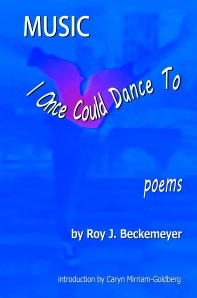
Music I Once could Dance To- Front Cover

My interview with poet, Roy Beckemeyer, ran Monday and Tuesday. Today, I'd like to feature Roy's first book of poetry, cover shown above. Some exciting news regarding the book is that it has been nominated for the High Plains Book Award in the poetry category. Results will be announced at the High Plains BookFest in Billings, MT October 2015. 

The poems in this book are ones that many readers can relate to. Roy does not write mystical verse that no one but the poet can decipher its meaning. He gives us poems about everyday happenings and memories of growing-up years. He takes the ordinary and makes it extraordinary for his readers. Upon reading the assorted poesm in the book, I couldn't help but assess as a writer--he shows rather than tells and that is one reason his poetry appeals so much.

In the Introdution to the book, Caryn Mirriam-Goldberg, former Kansas Poet Laureate, said "Roy has a way of approachign poetry that is both expansive and precise. He instinctively trusts the image of the poem to convey the poem's layers of meaning, and he also leaps off any familiar edge to try new forms, new inspirations, and new rhythms to construct and unearth new poetry."

I especially liked the poems that show the reader the deep love Roy has for his wife, Pat. Not an I love you, Pat type of poem. Instead, his feelings for her run softly through the lines of an everyday expericnce of husband and wife. One of my favorites is At Watermark Books Before The Reading. The poem describes husband and wife looking at books, his observations of her and finally ending with lines that touched my heart:

               and you look up,
              catch my eye,
              cup your hands,
             and motion for me to share a cold sip
             from this well of words
            that you have found.

Another poem I particularly liked is titled A Year in Small-Town Illinois: 1953 in Tanka. Using this poetic form, Roy explores the small town where he grew up, one month at a time. One of the verses that appealed a lot to me because of its wonderful visual image and the sensory detail in the second line is this one:

           February

           skating on Shoal Creek
           ice cracks like a rifle shot
           and transforms us both
           from skaters into swimmers
           huddled steaming by the fire

A poetry book is not to be read once and shelved. Oh no, it needs to read mutlitple times for you will find something new in it each successive reading. Lines you may have read but missed will suddenly stand out on the second or third reading. 

I believe one thing that impresses me about Roy Beckemeyer's poetry is the wide variety that he offers. The poems use different forms for various subjects.Some poets spend the majority of their writing life composing words about one or two subjects. In Music I Once Could Dance To, you'll be treated to many different topics.

The book can be ordered at Coal City Review and Press in Lawrence, KS for only $10. It is now in its second printing. 


A Memoir to Enjoy

  I recently read a book that I enjoyed so much that I wanted to share it with others.  Kenneth Goetz offers us his memoir titled A Streak o...