Showing posts with label preserving family stories. Show all posts

Thursday, May 22, 2025

Tips for Writing Family Stories


My regular readers know that one of my pet projects is encouraging people to write family stories. Writers and non-writers alike. You don't need to be a professional writer to record your family history through stories of incidents and events. Anyone can do it. 

There are websites to help. Use any search engine and enter 'how to write family stories', and you'll be amazed at the number of helpful articles that pop up. 

There is a difference between family stories and family history. The latter is made up of facts and figures...names and dates of marriages, births, deaths, places lived. Family stories are more personal letting future generations know more about the personalities of family members as well as significant things that happened within the family. Both good events and sad or bad. It's all part of your family history. You don't want to sugarcoat your family members in every story. Tell it like it is. Or was! You can do this without being nasty or cruel. 

My mother often mentioned an uncle of hers who she said was 'the meanest man on the earth'. When he died, he left money to all his nieces and nephews, so the man had a good side, as well. Many of our relatives have more than one side. Try to find the good side when you can.

A few tips when writing family stories: 

A. Use sensory details to make the individuals seem real--sight, sound, taste, touch, and smell.

B. Try to show the place where the story happens. City, farm, ranch, island, ocean? 

C. Do more than tell the story. Show us what happened. That's where the sense of place and sensory details come in.

D. Use active verbs instead of relying on passive ones like is, was, were, are. Active verbs help show while passive ones end up merely telling the story.

E. Use some adjectives to help with description, but keep it to one, two at the most. Otherwise, it sounds too saccharin.

F. Dialogue helps bring the story alive. You probably can't remember dialogue word for word, but you will remember the gist of what was said. It's alright to create dialogue as long as the meaning is the same as what was said.

G. Humor is always welcome in any story. There are many humorous things that happen in our families. They beg to be repeated.

H. Don't shy away from sad stories. They should be told. They are part of what makes people who they are. The same with tragic events in a family. Tell them with kindness.

I. It's not necessary to write the stories chronologically. Write them as they come to you. 

J. Describe the characters in your stories. What relation were they to you? Physical attributes. The kind of person he/she was. Weave all this into your individual story. 

Keep a file of the stories you write. Both on your computer and hard copies saved in a large 3-ring binder. Computers fail us at times, so those hard copies are important. 

Many people say they want to write their family stories. They think about it, they talk about it, but that's as far as it goes. Start with one story, save it, then go on to the next. You don't have to keep at it day by day. Write when the mood moves you but try to do it with some regularity. The longer you are away from the project, the easier it is to stay away. Maybe aim for one a week. 

If you write your family stories, you'll have a certain sense of satisfaction. Our family memories are treasures, so why not share them with other family members and leave them for future family members.  

Wednesday, August 12, 2015

Write Life Stories


Yesterday, I had the joy of listening to a set of twins tell their life story at a meeting I attended. They are 66 years old, were both teachers, and they still live together and often dress alike but not always. We laughed at many of the questions that people have asked them over the years about being twins and looking so much alike.  One was "Do you know which one you are?" The twins had pictures to show as they told their life story from infancy to today. 

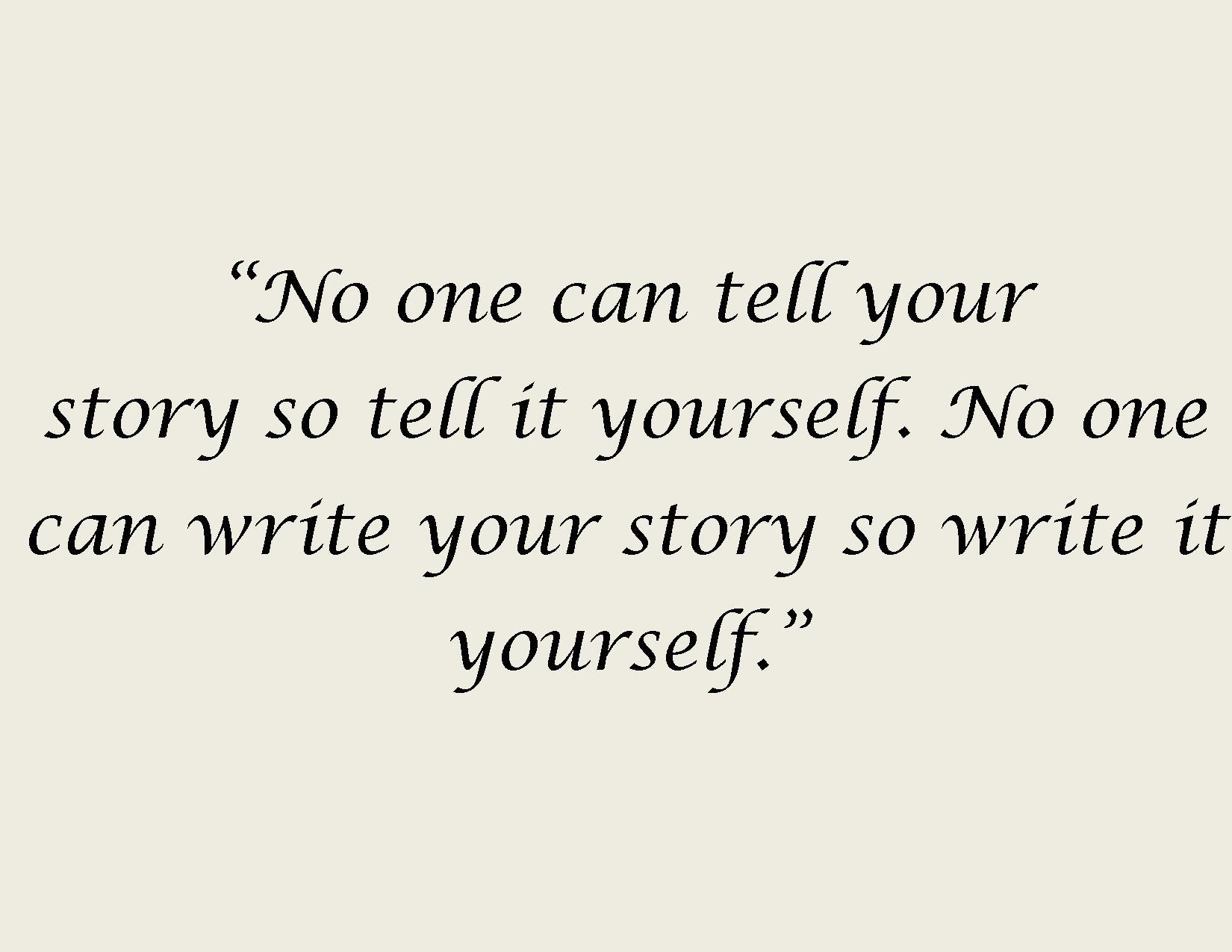
As the quote for today indicates, no one could have told the twins' story any better than they did themselves. I hope that someday they write their story for future generations, especially for any twins nieces and nephews might have. The highlights they gave yesterday made me think that they would have many wonderful incidents to put into a full written story.

You don't have to be a twin to tell or write your story. Telling is fine but writing will allow it to be shared by many over the years. My childhood of the 1940's and '50's was completely different than that of my four grandchildren growing up in the 21st century. I want them to know what life was like when their grandfather and I were kids. 

The thrill we got with our first television set, one with a teeny tiny round screen set in a big console is something they would most likely laugh about, But maybe it would help them appreciate their own 48 inch flat screen TV a bit more. Our grandchildren all live in houses but I grew up in a large apartment building. With over 60 apartments, we had our own little city. Our play place was concrete, not the grass they know. The minuscule freezer in our small fridge held one tray of ice cubes and a pint of ice cream. Theirs? Well, you know how today's freezers hold.

When my grandchildren go shopping with their mothers, they get in the car and speed off to the mall. My mother and I used public transportation--bus or elevated train--to get where we needed to shop.

I have written multiple stories about me and my family that I send to my children and grandchildren. I write the stories for them and for whatever children might come later. I could tell them the stories but if I write them, they are preserved forever. I do tell them the stories sometimes but I make sure they are also written.

Don't make it a I should do that sometime thing. If you haven't started already, set a goal to write one a month. You might enjoy it so much that you'll soon aim for one a week. Even if your grandchildren, or your own children, are still infants, write those stories now and you'll have them ready when they are older. When something triggers a memory, jot down a few notes so you can write the story later.

Write your own story but include your family members--parents, grandparents, siblings, aunts, uncles, cousins. They're all a part of your very own story. You don't have to be a professional or published author to write stories about your life. Anyone can do it.

The Our Echo website has a motto at the top that I've always liked. It says Everyone has a story. What's yours? This website for people to post their stories is not as active as it was when it had a strong leader but you can still read lots of good stories by people who are writers and people who are everyday folk wanting to preserve their family stories. 


Book Review: Winter Hearts

  Sme stories stay with you past your closing the final page. Christina Hamlett's latest book, Winter Hearts, is that kind of a read. I...